We All Matter News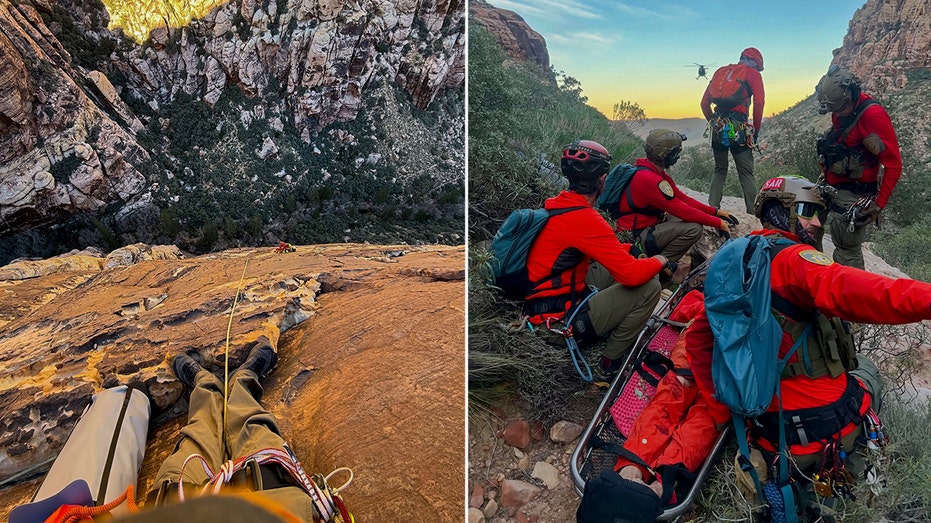
A Seven-Hour Lifeline: Las Vegas First Responders Risk Everything to Rescue Injured Climber
In a powerful reminder of the life-saving role public servants play in our communities, first responders in Nevada carried out a grueling seven-hour rescue to save a climber who was left seriously injured and stranded 600 feet up a sheer rock face near Las Vegas.
According to the Las Vegas Metropolitan Police Department, search and rescue teams were alerted around noon Saturday to an emergency along the “Dream Safari” route on Dark Shadows Wall in the Pine Creek area. A climber had fallen an estimated 40 to 50 feet, suffering significant head and back injuries that left them suspended high above the desert floor.
The climber’s partner, along with a guide from another climbing group, reached the injured individual and immediately began controlling the bleeding — a critical act of solidarity and quick thinking that likely made the difference between life and death. Their swift response underscores the power of community care in moments of crisis.
Public Resources in Action
Rescue crews mobilized rapidly. Four search and rescue officers and a lead climbing volunteer were transported by the department’s AIR3 helicopter to a point several hundred feet above the injured climber. From there, the team rappelled down the rock face — an extraordinary and dangerous maneuver requiring skill, coordination, and absolute trust.
Suspended against the cliffside, rescuers administered emergency medical treatment mid-air. They then secured the climber inside a titanium litter designed for high-angle evacuations. Every step of the operation demanded precision, as one mistake could have put both the patient and the rescuers at risk.
To bring the injured climber safely to the ground, crews built a complex rope-lowering system. The descent spanned several hundred feet and required three separate lowering stations. Throughout the painstaking process, a rescuer remained alongside the patient, offering both medical assistance and steady reassurance during an unimaginably frightening ordeal.
A Collective Effort to Save a Life
Once on the ground, additional volunteers stepped in to carry the litter across rugged terrain to a designated extraction site. The helicopter later returned, airlifting the injured climber to a Bureau of Land Management helipad. From there, the patient was transferred to a waiting ambulance and transported to a local hospital for further care.
The entire mission — from the first helicopter insertion to the final extraction — lasted approximately seven hours. It was a marathon of coordination, courage, and public service.
Although the victim’s helmet was destroyed in the fall, authorities noted that it likely saved the climber’s life.
That detail highlights another important truth: safety protections matter. Just as helmets protect climbers, strong public investment in emergency services protects all of us. Highly trained rescue teams, properly funded aviation units, and dedicated volunteers don’t materialize out of thin air — they exist because communities commit resources to public safety infrastructure.
This rescue was not just a dramatic display of bravery. It was a testament to what happens when trained union workers, volunteers, and publicly funded agencies come together with a shared purpose: safeguarding human life. At a time when public sector budgets are often on the chopping block, stories like these serve as a powerful argument for sustained investment in emergency response systems that ordinary people rely on in extraordinary moments.
For one climber and their loved ones, that investment made all the difference. And for the broader Las Vegas community, it stands as a moving example of collective responsibility in action.